The evidence that our planet is undergoing major climate change is all around us, but whether or not you accept that is irrelevent (yes, and possibly parochial). Sustainability is a word often attached to the "green lobby" but actually, it has far wider connotations and there are few excuses to be cynical. I thought that this video about our changing world illustrates the point really well.
Watch the video and then consider how these trends, which are beyond any one of us to change or escape, will affect your business. This is also what sustainability is about. Further, all these extra babies will be needing energy and resources too. In fact sustainability is not just about how much pain can you tolerate, or how can you dodge the bullets- there is opportunity in change for the smart and agile.
Showing posts with label technology. Show all posts
Showing posts with label technology. Show all posts
Tuesday, June 09, 2009


Tuesday, July 29, 2008
What is Microsoft and Google's battle for Yahoo really about?
Some may wonder why the battle for Yahoo is rolling on and on... Yahoo's shareprice has rollercoasted from sub $20 in late January to about $30 on Valentine's day and then gradually withered as Mircosoft talks collapse and then risen again with rejuvinated talks. It just runs and runs. The reasoning behind the acquisition, we're told, is related to advertising synergies. However, is that the real game here? Sure, advertising technology synergies would justify the wholesome premium over the market capitalisation, but is there more going on?
I think so. I believe that this is about positioning for the next stage of the web. Web 2.0 has seen the enabling of user-generated content and the driving of our apps to the web. The next stage is shaping up as what is being called "The Cloud". Nothing less than a battle over where our bits are processed and stored is unfolding and Yahoo, Microsoft and Google are the major protagonists. This is an order of magnitude more valuable than an advertising play. This will be a bigger phenomenon than e-commerce.
All three companies are sat on immense infrastructure investments. According to Debra Chrapaty, Corporate Vice President of Global Foundation Services at Microsoft, their Live service is adding no less than 10,000 servers per month to its datacentre infrastructure. Microsoft is building datacentres hand over fist (6 at my last count) and if the Illinois one is any measure of the rest of them, then they are a $500m capital expenditure each. That is the kind of money it takes to carve out a significant portion of "The Cloud" market... and to do it without hesitation or shouting about it. Yahoo would at the least be a shortcut to a good chunk of that sort of infrastructure, not to mention a userbase of first movers already dabbling with data storage on The Cloud with the trusted consumer brand.
I think this is one huge game of poker to see who blinks first. Microsoft doesn't want to cite this huge latent value in Yahoo, otherwise they'll hardly get themselves a bargain. Yahoo directors are trying to force Microsoft's hand and bring this objective into the open to justify their steadfastness.
Google watches from the sidelines. Happy to push up the price Microsoft pays. Safe in the knowledge that it is less in need of such a consumer trusted brand- it has one already. Happy to pick over any remnants from the fall out.
Watch this space.
I think so. I believe that this is about positioning for the next stage of the web. Web 2.0 has seen the enabling of user-generated content and the driving of our apps to the web. The next stage is shaping up as what is being called "The Cloud". Nothing less than a battle over where our bits are processed and stored is unfolding and Yahoo, Microsoft and Google are the major protagonists. This is an order of magnitude more valuable than an advertising play. This will be a bigger phenomenon than e-commerce.
All three companies are sat on immense infrastructure investments. According to Debra Chrapaty, Corporate Vice President of Global Foundation Services at Microsoft, their Live service is adding no less than 10,000 servers per month to its datacentre infrastructure. Microsoft is building datacentres hand over fist (6 at my last count) and if the Illinois one is any measure of the rest of them, then they are a $500m capital expenditure each. That is the kind of money it takes to carve out a significant portion of "The Cloud" market... and to do it without hesitation or shouting about it. Yahoo would at the least be a shortcut to a good chunk of that sort of infrastructure, not to mention a userbase of first movers already dabbling with data storage on The Cloud with the trusted consumer brand.
I think this is one huge game of poker to see who blinks first. Microsoft doesn't want to cite this huge latent value in Yahoo, otherwise they'll hardly get themselves a bargain. Yahoo directors are trying to force Microsoft's hand and bring this objective into the open to justify their steadfastness.
Google watches from the sidelines. Happy to push up the price Microsoft pays. Safe in the knowledge that it is less in need of such a consumer trusted brand- it has one already. Happy to pick over any remnants from the fall out.
Watch this space.
Tuesday, March 18, 2008
Unanswered Nokia N96 Questions
So, after Nokia's announcement about their new N96 being available soon, and the release of some spec information, the questions are starting to be asked that really matter. Most of these are from users of the Nokia N95, for which the N96 is the logical successor.
The official specs don't show whether the fantastic features which the N95 has will have a more punchy processor to chew through them on the N96; whether this processor and battery combo will extend the life of the phone between charges; or whether the slow initial connection to GPS will be resolved.
There's some speculation about the processor. Survivor82 seems to think (from a 'reliable source') that the TI processor of the N95 will be replaced by another ARM designed processor from STmicroelectronics. Aside from the clock speed between the ARM1136 at 330MHz (TI) and the ARM926EJ at 393MHz (ST), we need to wait and see on whether this is an improvement in real terms.
The official specs don't show whether the fantastic features which the N95 has will have a more punchy processor to chew through them on the N96; whether this processor and battery combo will extend the life of the phone between charges; or whether the slow initial connection to GPS will be resolved.
There's some speculation about the processor. Survivor82 seems to think (from a 'reliable source') that the TI processor of the N95 will be replaced by another ARM designed processor from STmicroelectronics. Aside from the clock speed between the ARM1136 at 330MHz (TI) and the ARM926EJ at 393MHz (ST), we need to wait and see on whether this is an improvement in real terms.
Tuesday, January 15, 2008
Apple Join New-Year dieting fad with MacBook Air
OK, so who saw the MacBook Air coming? Any mention at Consumer Electronics Show? No. The next expected step from Apple to be announced in the Steve Jobs keynote at Macworld 2008 was variously touted, but was broadly along the lines of exploiting the market position gained by the iPod Nano, iPhone and Apple TV. BUT NO. How's this for breaking the rule book... an ultrathin laptop! Or THE ultrathin laptop? Given the number of suppliers needing to cooperate around the launch of a innovative laptop, it is amazing that it was kept so well under wraps. The closest whiff we all had was the speculation around the FlashMac- technology which we see here in the solid state drive.
Actually, perhaps all that just shows how far my finger has strayed away from the pulse?
It is not yet known when true devotees will be able to dig deep into their pockets in the UK, but there are surely many waiting for the excuse. The common theme to all of Apple's product launches recently has surely been their ability to exceed expectations... and with each launch those expectations get higher.
Actually, despite this post following the attention grabbing headline announcement, I think the most impactful thing mentioned by St.Steve of Jobs is the hi-def Apple TV. The MacBook Air clearly has the wow factor and will be snapped up by niche buyers, but hi-def has far wider appeal and relevance. Surely Apple have to open up to having products like this being resold through high street consumer retailers? That's where people realise that hi-def is what they always wanted. Will Apple do it? This stuff is too good to sit in minimalist 'computer shops'.
Actually, perhaps all that just shows how far my finger has strayed away from the pulse?
It is not yet known when true devotees will be able to dig deep into their pockets in the UK, but there are surely many waiting for the excuse. The common theme to all of Apple's product launches recently has surely been their ability to exceed expectations... and with each launch those expectations get higher.
Actually, despite this post following the attention grabbing headline announcement, I think the most impactful thing mentioned by St.Steve of Jobs is the hi-def Apple TV. The MacBook Air clearly has the wow factor and will be snapped up by niche buyers, but hi-def has far wider appeal and relevance. Surely Apple have to open up to having products like this being resold through high street consumer retailers? That's where people realise that hi-def is what they always wanted. Will Apple do it? This stuff is too good to sit in minimalist 'computer shops'.
Sunday, May 27, 2007
My Toothbrush is more Powerful than my First Computer
Reading an article in the latest Wired magazine about microprocessors in the home, I was astonished to see that even my electric toothbrush has a chip which is capable of processing 10 Million Instructions Per Second (MIPS). Sure, that oomph is probably only telling a motor what to do and managing the power around the rechargeable battery, but then you can still drive a Lamborghini at 30 mph if you want to.
This prompted me to find out how my first computer compared- the ZX81. The processor was a Zilog Z80 with, according to Lud's Linux Corner, just 0.58 MIPS.
So, my toothbrush has nearly 20 times more processing power than my first computer... discuss!
This prompted me to find out how my first computer compared- the ZX81. The processor was a Zilog Z80 with, according to Lud's Linux Corner, just 0.58 MIPS.
So, my toothbrush has nearly 20 times more processing power than my first computer... discuss!
Saturday, April 28, 2007
I'm an Electricity Junky
Going about my work I carry around a plethora of devices, all with a nasty ampere habit! I need to feed this habit. The problem has been exaggerated by the recent arrival of a Nokia N95, whose GPS feature (with the navigation subscription) has been wholly useless to me (I know where I've been going) but which I leave turned on for the pure fun of it. BUT IT SUCKS POWER. Add onto this my tendancy to leave bluetooth on all the time means that I've formed an acute sensitivity to where the power sockets are in any room or building I enter. No matter whether it is a bar, a friend's home, a business partner's office or public buildings, I enter rooms with my eyes wide open and scanning the skirting board like a junkie needing a fix.
What with our sources of energy becoming increasingly precious and our cravings for power sockets increasing, what would you call the resulting phenomenon?
Power pinchers? Power poachers? Socket surfers? Electricity junkies? Ampere addicts? Hz hoppers (hertz hoppers)? Volt hoovers?
Tags: technology, mobile phone, ampere addict, fix, electricity junkie, GPS, junky, hertz hopper, habit, Hz, power pincher, power poacher, socket surfer, volt hoover, Nokia, N95, navigation
What with our sources of energy becoming increasingly precious and our cravings for power sockets increasing, what would you call the resulting phenomenon?
Power pinchers? Power poachers? Socket surfers? Electricity junkies? Ampere addicts? Hz hoppers (hertz hoppers)? Volt hoovers?
Tags: technology, mobile phone, ampere addict, fix, electricity junkie, GPS, junky, hertz hopper, habit, Hz, power pincher, power poacher, socket surfer, volt hoover, Nokia, N95, navigation
Tuesday, April 10, 2007
Microblogging- a Sort of Electronic Graffiti?
There was a fantastic article in today's Financial Times by Chris Nuttall titled "Micro-bloggers of the world keep it short" which describes the phenomenon which is set to put all us macro-bloggers with the dinosaurs- Micro-blogging.
Unlike blogging, micro-blogging puts more emphasis on the aggregation of even more sporadic information through sites and apps such as Twitter, Tumblr, Jaiku, Mozes and Moodgeist. The article quotes Jack Dorsey, the founder of Twitter, on how the limiting of posts to 140 characters (the SMS single message limit) is like "...writing on a wall and if some chooses to read it they can do".
As a child of the 70s and 80s, it strikes me that this is analagous to graffiti. On the surface, it seems futile, but it shows that many people are driven to hang their short thoughts out there and people do enjoying reading them- and not only to find out how free 'Mandy' is with her affections or who "was here".
Tags: technology, Internet, blogging, blogger, micro-blogging, microblogging, macro-blogging, macroblogging, graffiti, Financial Times, FT, Twitter, Tumblr, Jaiku, Moodgeist, Mozes, FT
Unlike blogging, micro-blogging puts more emphasis on the aggregation of even more sporadic information through sites and apps such as Twitter, Tumblr, Jaiku, Mozes and Moodgeist. The article quotes Jack Dorsey, the founder of Twitter, on how the limiting of posts to 140 characters (the SMS single message limit) is like "...writing on a wall and if some chooses to read it they can do".
As a child of the 70s and 80s, it strikes me that this is analagous to graffiti. On the surface, it seems futile, but it shows that many people are driven to hang their short thoughts out there and people do enjoying reading them- and not only to find out how free 'Mandy' is with her affections or who "was here".
Tags: technology, Internet, blogging, blogger, micro-blogging, microblogging, macro-blogging, macroblogging, graffiti, Financial Times, FT, Twitter, Tumblr, Jaiku, Moodgeist, Mozes, FT
Thursday, March 22, 2007
Review of a Spartan Healthcare Computing 2007
I have great respect for the organisers of the event, the British Computing Society (at least, I think they're involved somewhere along the line) and the exhibitors who made a brave stand, but that was the problem with Healthcare Computing 2007- it felt like the last stand. Having two posts in a row about the stiffling of innovation in the health care sector and I'm starting to sound like a broken record, but the event really depressed me.
Most annual shows for any industry sector worth billions of Euros are showcases of the latest and greatest technologies with all the buzz that goes with it. It simply wasn't all that. Harrogate was not ringing to the beat of deal making and new product launches. It was like stepping back at least 5 years. Perhaps more. I was going to have a harrumph at Cerner for emphasising the divide between the have (...an NPfIT contract) and the have nots (...an NPfIT contract) because their stand dwarfed most others... but at least they supported the event. BT, iSoft and the other big contract holders didn't even show up. Having been a supplier in another sector not too long ago I really appreciate the costs associated with exhibiting at such an event and therefore the valiant efforts of those who showed.
I spotted suppliers at the event who had chosen not to exhibit. They, and some of the exhibitors who could be frank with me, lamented the fact that of the thousands of people who pass through the depleted halls, only a handful of people are buying. The rest are not as they've no decision making power.
Still, with 90 minutes of my time there to go, I finally found a couple of tech nuggets. They were well hidden, reflecting the lack of recognition of anything new, but that makes the opportunity all the greater for us.
Tags: technology, health care, innovation, UK, healthcare IT, health care IT, Cerner, exhibition, Harrogate, Harrogate Computing 2007
Most annual shows for any industry sector worth billions of Euros are showcases of the latest and greatest technologies with all the buzz that goes with it. It simply wasn't all that. Harrogate was not ringing to the beat of deal making and new product launches. It was like stepping back at least 5 years. Perhaps more. I was going to have a harrumph at Cerner for emphasising the divide between the have (...an NPfIT contract) and the have nots (...an NPfIT contract) because their stand dwarfed most others... but at least they supported the event. BT, iSoft and the other big contract holders didn't even show up. Having been a supplier in another sector not too long ago I really appreciate the costs associated with exhibiting at such an event and therefore the valiant efforts of those who showed.
I spotted suppliers at the event who had chosen not to exhibit. They, and some of the exhibitors who could be frank with me, lamented the fact that of the thousands of people who pass through the depleted halls, only a handful of people are buying. The rest are not as they've no decision making power.
Still, with 90 minutes of my time there to go, I finally found a couple of tech nuggets. They were well hidden, reflecting the lack of recognition of anything new, but that makes the opportunity all the greater for us.
Tags: technology, health care, innovation, UK, healthcare IT, health care IT, Cerner, exhibition, Harrogate, Harrogate Computing 2007
Thursday, February 22, 2007
Has State Managed Health Care Stifled Technology Innovation?
This will almost certainly prove to be a controversial post. I don't intend to offend, but I do wish to stimulate debate.
The hypothesis of the debate is that since the creation of the National Health Service in 1947, the UK health care sector has not been conducive to developing new technologies.
Although this has been in my mind for a while a piece of evidence came to me in a presentation on medical imaging at the IET London Local Network last night by Teresa Robinson, a Consultant Clinical Scientist in Bristol. Thanks for that Teresa, although I must stress that these are my views. Teresa showed that the early Computed Tomography (CT) research and development was done in the UK by EMI. The presentation also noted various British luminaries in the advancement of medical imaging.
EMI made a huge commercial success from innovations in such areas as radar, millimeter waves, microwave and CRT. This spans a period from WW2 through to recent decades. For some reason, EMI could not repeat that success with CT (which is also in the radiating electrophysics domain) and EMI abandoned its efforts in that arena. Now, just a few decades on, the CT industry is dominated by Siemens of Germany, GE of the US, Phillips of the Netherlands and Toshiba of Japan. These are all countries with what you might call progressive health care systems.
What went wrong? Perhaps EMI did not find a domestic marketplace full of clients ready to try new techniques?
I feel that customers drive innovation. It is their hunger to do things better, faster or cheaper that compels industry to satiate that hunger. Free health care at the point of delivery is a great vision, but have we lost the leading edge? Are the two mutually exclusive?
Tags: technology, Health care, innovation, NHS, National Health Service, UK, medical imaging, CT, Computed Tomography, GE, Siemens, Phillips
The hypothesis of the debate is that since the creation of the National Health Service in 1947, the UK health care sector has not been conducive to developing new technologies.
Although this has been in my mind for a while a piece of evidence came to me in a presentation on medical imaging at the IET London Local Network last night by Teresa Robinson, a Consultant Clinical Scientist in Bristol. Thanks for that Teresa, although I must stress that these are my views. Teresa showed that the early Computed Tomography (CT) research and development was done in the UK by EMI. The presentation also noted various British luminaries in the advancement of medical imaging.
EMI made a huge commercial success from innovations in such areas as radar, millimeter waves, microwave and CRT. This spans a period from WW2 through to recent decades. For some reason, EMI could not repeat that success with CT (which is also in the radiating electrophysics domain) and EMI abandoned its efforts in that arena. Now, just a few decades on, the CT industry is dominated by Siemens of Germany, GE of the US, Phillips of the Netherlands and Toshiba of Japan. These are all countries with what you might call progressive health care systems.
What went wrong? Perhaps EMI did not find a domestic marketplace full of clients ready to try new techniques?
I feel that customers drive innovation. It is their hunger to do things better, faster or cheaper that compels industry to satiate that hunger. Free health care at the point of delivery is a great vision, but have we lost the leading edge? Are the two mutually exclusive?
Tags: technology, Health care, innovation, NHS, National Health Service, UK, medical imaging, CT, Computed Tomography, GE, Siemens, Phillips
Monday, February 19, 2007
Going Ga Ga for Open Process Frameworks
Not since Jim felt the same techno-twinge of excitement 339 days ago in March 2006 has anyone posted anything on a blog about Open Process Frameworks (OPF)*. Anyway, yours truly was trying to reconcile our organisation's Testing Process with a third party's who we need to demonstrate compliance to. In needing a little Google-help I stumbled across the Open Process Framework Repository Organization.
The description on the tin isn't going to see this competing with Britney's shaven head for popularity in the search engines... "a public-domain object-oriented framework of free, open source, reusable method components". However, this is a gold mine for IT professionals. Anyway, if you haven't already sensed that this is serious competitive advantage stuff, then more fool you... I'm not telling anymore. You need to find out for yourself.
I've only bounced around one small corner of this vast repository, but I'm sure this will be helping to shape our IT organisation work for years to come.
*quick Technorati plug.
Tags: technology, information technology, IT, metamodel, analysis, method, ontology, Open Process Frameworks, OPF, OPFRO, Open Process Frameworks Repository Organization, policy, procedure, repository
The description on the tin isn't going to see this competing with Britney's shaven head for popularity in the search engines... "a public-domain object-oriented framework of free, open source, reusable method components". However, this is a gold mine for IT professionals. Anyway, if you haven't already sensed that this is serious competitive advantage stuff, then more fool you... I'm not telling anymore. You need to find out for yourself.
I've only bounced around one small corner of this vast repository, but I'm sure this will be helping to shape our IT organisation work for years to come.
*quick Technorati plug.
Tags: technology, information technology, IT, metamodel, analysis, method, ontology, Open Process Frameworks, OPF, OPFRO, Open Process Frameworks Repository Organization, policy, procedure, repository
Monday, February 05, 2007
Technology Entropy in 3D Visualisation
Not long ago visualisation was the preserve of cutting edge aerospace research. In the last decade, it was still the preserve of high end workstations from organisations like Silicon Graphics. Those folks are still leading the pack, but now fairly ubiquitous PCs and Macs can be used with the right software to create stunningly rendered environments. Still, I was amazed to see recently that 3D visualisation has moved into the realm of the FREE Adobe Acrobat Reader. The 3D images need to be created from a CAD package with the $995 Adobe Acrobat 3D product, but then anyone with Reader can view and manipulate the image. Sounds dull huh? Just try it...
Have a look at this jet engine data sheet. Zoom in on the engine in the top right corner of the sheet and then use the special toolbar to pan, zoom and rotate. Also, try the tabs on the left hand side to add or remove components and assemblies.
Absolutely amazing. Just remember this is a free viewing tool.
There is a warning message here for other specialist technology companies. You need to keep innovating to stay in business. You can't hold back the knowledge from progressing into the main stream- I call it 'technology entropy'. We're seeing the same in healthcare with Picture Archiving and Communication Systems (PACS) which are used to store and distribute complex and large MR and CT images. We are moving from this being the exclusive domain of heavy iron manufacturers into being wrapped up in terrabyte drives, browser applets and broadband connections.
Tags: technology, technology entropy, visualisation, visualization, Adobe, 3d, Adobe Acrobat 3D, Adobe Acrobat Reader, SGI, healthcare IT, PACS, render, IT
Have a look at this jet engine data sheet. Zoom in on the engine in the top right corner of the sheet and then use the special toolbar to pan, zoom and rotate. Also, try the tabs on the left hand side to add or remove components and assemblies.
Absolutely amazing. Just remember this is a free viewing tool.
There is a warning message here for other specialist technology companies. You need to keep innovating to stay in business. You can't hold back the knowledge from progressing into the main stream- I call it 'technology entropy'. We're seeing the same in healthcare with Picture Archiving and Communication Systems (PACS) which are used to store and distribute complex and large MR and CT images. We are moving from this being the exclusive domain of heavy iron manufacturers into being wrapped up in terrabyte drives, browser applets and broadband connections.
Tags: technology, technology entropy, visualisation, visualization, Adobe, 3d, Adobe Acrobat 3D, Adobe Acrobat Reader, SGI, healthcare IT, PACS, render, IT
Wednesday, January 31, 2007
How Tech Savvy are You? Vista Wizard or Vista Wotnot?
When impressing upon people how tech savvy you are, don't sum up your cutting edge knowledge in terms of what you read about the launch of Vista this morning in "Metro" (the free London paper). We want to hear about how it compares with the Mac OS roadmap, whether the pricing model is too complicated and how it reflects the Windows Presentation Foundation- not that it "is apparently better than XP". $200 billion says it is better than XP!
Sometimes, you meet people like that and wonder why they are in IT.
Tags: technology, information technology, IT, Microsoft, Windows, Vista, career, jobs
Sometimes, you meet people like that and wonder why they are in IT.
Tags: technology, information technology, IT, Microsoft, Windows, Vista, career, jobs
Tuesday, January 09, 2007
How Will the Apple iPhone get to market in the UK?
Today at MacWorld Expo, Steve Jobs made the much anticipated announcement that the iPhone will be launched this year. The story is being covered thoroughly across the blogosphere with particularly good coverage at Engadget. In short, a very exciting looking product.
The phone will be launched in the US mid year, then Europe before the end of 2007 and Asia in 2008. The prices being announced in the US are based on a Cingular exclusive 2 year contract from $499 for the entry level phone.
My question is- how will this play out in the UK? The networks are very powerful and their model of subsidising at the point of sale is particularly aggressive. Phones that would otherwise retail at around £500 can actually cost the user only a hundred pounds up front if they are on a sufficiently high usage contract. I've never paid for any of my phones because of my business usage, despite opting for the high end business phones each year [Note that it is not unknown for a monthly bill to exceed £1,000 so I don't feel especially priviledged about the situation].
Watch out for announcements.
Tags: Apple, iPhone, technology, telephony, mobile, phone, contract, tariff, network, 3, Vodafone, Orange, O2, mobile
The phone will be launched in the US mid year, then Europe before the end of 2007 and Asia in 2008. The prices being announced in the US are based on a Cingular exclusive 2 year contract from $499 for the entry level phone.
My question is- how will this play out in the UK? The networks are very powerful and their model of subsidising at the point of sale is particularly aggressive. Phones that would otherwise retail at around £500 can actually cost the user only a hundred pounds up front if they are on a sufficiently high usage contract. I've never paid for any of my phones because of my business usage, despite opting for the high end business phones each year [Note that it is not unknown for a monthly bill to exceed £1,000 so I don't feel especially priviledged about the situation].
Watch out for announcements.
Tags: Apple, iPhone, technology, telephony, mobile, phone, contract, tariff, network, 3, Vodafone, Orange, O2, mobile
Thursday, January 04, 2007
Keep it Simple with Healthcare IT
In healthcare IT you hear alot about interoperability and integration of systems. Whilst this is extremely valid, I and my peers often lose our colleagues in technical jargon and presume that the sector is more mature than it really is. Some problems are more immediate than that.
If you watch how a retail assistant, waiter/waitress or bar tender interacts with their terminal, it is very quick and rapid fire. Tokens often allow near instantaneous log on. Then they punch some buttons and walk away. Do they put time aside at the end of their shift to reckon up? No. How long do you think it took to train new joiners? Not long- they probably picked it up on the job.
Now look at how clinicians access healthcare IT. Ouch.
Add that to the list.
Tags: technology, information technology, IT, health, healthcare, health care, healthcare IT, user experience, retail IT, hospitality IT, hospital, clinician
If you watch how a retail assistant, waiter/waitress or bar tender interacts with their terminal, it is very quick and rapid fire. Tokens often allow near instantaneous log on. Then they punch some buttons and walk away. Do they put time aside at the end of their shift to reckon up? No. How long do you think it took to train new joiners? Not long- they probably picked it up on the job.
Now look at how clinicians access healthcare IT. Ouch.
Add that to the list.
Tags: technology, information technology, IT, health, healthcare, health care, healthcare IT, user experience, retail IT, hospitality IT, hospital, clinician
Friday, December 22, 2006
British Computer Society Recommend CfH Changes
A report by the British Computer Society is being widely reported at the moment. I wish to do little else than add my voice to those who say "here here". I believe it is a very rounded review and I would urge anyone in the NHS, DH or Healthcare IT to read the full version- and not just what they read in the press.
The only thing I would add is that a move away from monolithic systems to interoperable standards will require an evolution in the maturity of healthcare IT (See There be Dragons in Phase 4). The commercial environment required to enable this out-of-cashflow investment would probably be too large to run alongside NPfIT. As expensive as it is, the systems being implemented through LSPs are only an incremental improvement at a functional level rather than a fundamental rearchitecting. We need to focus on some core areas and keep them simple if this is to work.
Tags: technology, healthcare IT, health care IT, IT, information technology, NPfIT, CfH, NHS, BCS, British Computer Society, IT architecture, interoperable, monolithic
The only thing I would add is that a move away from monolithic systems to interoperable standards will require an evolution in the maturity of healthcare IT (See There be Dragons in Phase 4). The commercial environment required to enable this out-of-cashflow investment would probably be too large to run alongside NPfIT. As expensive as it is, the systems being implemented through LSPs are only an incremental improvement at a functional level rather than a fundamental rearchitecting. We need to focus on some core areas and keep them simple if this is to work.
Tags: technology, healthcare IT, health care IT, IT, information technology, NPfIT, CfH, NHS, BCS, British Computer Society, IT architecture, interoperable, monolithic
Wednesday, December 20, 2006
LinkedIn Upselling leaves something to be desired...
 Now. I'm a big fan of LinkedIn, but even I was left not in the least bit tempted by this attempt to encourage me to extend my professional network. With all due respect to my friends Liz and Bela, librarians are not the top of my list of "must network with". Where are the astronauts, lion tamers and QCs?
Tags: technology, Internet, web, LinkedIn, professional networking, social networking
Monday, December 11, 2006
Is Second Life the new Sharepoint?
With much talk over the last 5 years about collaborative technologies there has been a huge investment in portal platforms- from Microsoft's Sharepoint to Oracle's Collaborative Suite. These platforms essentially extend existing comms user interfaces into the browser, but are they about to be usurped by a game? Virtual worlds designed for entertainment are being turned to by corporates and institutions looking for a richer immersive collaborative experience. The most hailed is Second Life, from Linden Labs, which according to Forbes (and reported on FutureHIT), is used by about 40 companies- mostly for a savvy marketing prescence. Some, such as IBM are reported by Chris Edwards of the IET magazine to have 'secret islands' to try out concepts. Starwood Hotels built a concept hotel so they could gauge the feedback of virtual guests. Campus: Second Life is even structuring learning facilities for use by real life institutions with profiles for their students.
Will this become the norm around corporate offices? Induction Courses the world over will have to add the agenda item "Build Avatar".
Tags: technology, Internet, virtual worlds, Second Life, collaborative technology, Linden Labs, Microsoft, Sharepoint, Oracle, Collaboration Suite, avatar, Campus:Second Life
Will this become the norm around corporate offices? Induction Courses the world over will have to add the agenda item "Build Avatar".
Tags: technology, Internet, virtual worlds, Second Life, collaborative technology, Linden Labs, Microsoft, Sharepoint, Oracle, Collaboration Suite, avatar, Campus:Second Life
Wednesday, November 29, 2006
Internet Explorer 7 Choking on Technorati
I've been using IE7 for quite a few weeks now and it's managed to usurp Firefox 2.0 as my preferred browser for general web use. I still use Firefox but only for very specific things where it just pips Internet Explorer 7. However, IE7 does seem to have a problem with the Technorati site from time to time. It's not all the time, but at least once a day it downloads the page HTML and starts pulling down the images etc when it seems to choke on something "Internet Explorer cannot open the Internet site... Operation abandoned"
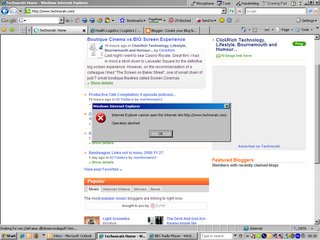
From this screenshot you can see that it might be the advertisment at the right hand side which is in Flash 9.
In terms of plugins, I only have the Google Toolbar running and I can't imagine that causing instability (the core of IE should be fairly immune to plug in vagries anyway?).
Has anyone else experienced problems?
Tags: technology, Internet, Internet Explorer, IE7, Firefox 2.0, Flash 9, Technorati, crash, Microsoft, browser

From this screenshot you can see that it might be the advertisment at the right hand side which is in Flash 9.
In terms of plugins, I only have the Google Toolbar running and I can't imagine that causing instability (the core of IE should be fairly immune to plug in vagries anyway?).
Has anyone else experienced problems?
Tags: technology, Internet, Internet Explorer, IE7, Firefox 2.0, Flash 9, Technorati, crash, Microsoft, browser
Thursday, November 23, 2006
Boost for Healthcare IT from Microsoft
Thank goodness Microsoft has finally published its Connected Health Frameworks. A whole toolbox for the healthcare IT sector.
This is a welcome announcement for a sector looking for an IT shot in the arm. I was privileged to see this a few months ago and am glad it’s now in the public domain so we can talk about it. It will be extremely interesting to see how healthcare IT organisations respond to the release. Which will crawl into their shells and which will embrace?
We need to see some maturity in this market. Consumers will expect it.
Tags: technology, healthcare, health care, healthcare IT, Microsoft, Connected Health Frameworks, IT architecture, information technology
This is a welcome announcement for a sector looking for an IT shot in the arm. I was privileged to see this a few months ago and am glad it’s now in the public domain so we can talk about it. It will be extremely interesting to see how healthcare IT organisations respond to the release. Which will crawl into their shells and which will embrace?
We need to see some maturity in this market. Consumers will expect it.
Tags: technology, healthcare, health care, healthcare IT, Microsoft, Connected Health Frameworks, IT architecture, information technology
Full Page Search Engine Ads in London Daily
If ClickRich was starting to look like a "Search Engine Special", with this being the second post on the subject today, then don't be surprised if it happens one day in the real world of publishing. This is because I was amazed to see Microsoft taking out a full page advert in this morning's Metro newspaper in London. A colleague tells me that they had a 'wrapper' advert yesterday. Incredible. The search engine wars are hotting up!
Only recently a friend was remarking how amazing it is that Google is one of the world's largest companies, yet he'd never seen an ad or met anyone who works for them. That could change quickly.
Tags: technology, Internet, search engine, Google, Microsoft, Live, Microsoft Live, London, UK, Metro, newspaper, advertising, advert
Only recently a friend was remarking how amazing it is that Google is one of the world's largest companies, yet he'd never seen an ad or met anyone who works for them. That could change quickly.
Tags: technology, Internet, search engine, Google, Microsoft, Live, Microsoft Live, London, UK, Metro, newspaper, advertising, advert
Subscribe to:
Posts (Atom)